
How to Find UGC Creators Who Actually Convert
How to Find UGC Creators Who Actually Convert
The fastest way to find UGC creators is to run three channels at once: post a brief on a marketplace like Billo, Insense, or JoinBrands for speed; search TikTok and Instagram hashtags for authentic, low-cost finds; and tap your own customers through gifting for the highest trust factor. Use marketplaces when you need content in days, social search when you want a specific look or niche fit, and gifting when authenticity matters more than turnaround.
Here’s how to split your first move by goal:
- Need content this week? Post a brief on a marketplace and filter by niche and past brand work.
- Testing a new hook or angle? Search two or three hashtags on TikTok, DM five creators today.
- Building a long-term roster? Start a gifting program with your top 20 repeat customers.
Your next 30 minutes: pick one channel, write a two-sentence brief, and send it to five creators before you close this tab.
Key Takeaways
Finding UGC creators works best as a three-channel system: marketplaces for speed, social search and gifting for authenticity, and discovery tools for proven reliability, all fed into a structured testing loop.
| Point | Details |
|---|---|
| Match channel to goal | Use marketplaces for speed, gifting for authenticity, discovery tools for proven brand-deal history. |
| Brief for the first 3 seconds | A specific opening instruction outperforms a generic “make a UGC video” request. |
| Lock rights before you pay | Get explicit written permission for paid ad use, including license length and exclusivity terms. |
| Vet beyond follower count | Check engagement quality, past UGC examples, and delivery reliability before hiring. |
| Test before you scale | Stefanomazzei helps DTC brands brief creators, run head-to-head tests, and scale winning creative with a clear refresh cadence. |
Table of Contents
- Where to Find UGC Creators: Six Sourcing Channels Compared
- How Do UGC Marketplaces and Discovery Tools Actually Work?
- How to Search TikTok and Instagram for UGC Creators
- Running a Gifting Program That Produces Ad-Ready Content
- What to Include in a UGC Brief and How to Lock Down Rights
- How Do You Vet a UGC Creator Beyond Follower Count?
- Scaling UGC Into a Repeatable Paid Creative System
- Frequently Asked Questions
- Sources
Where to Find UGC Creators: Six Sourcing Channels Compared
Every sourcing channel trades speed for control, or cost for authenticity. Knowing which trade-off you’re making prevents wasted briefs and awkward back-and-forth overrates.
- Marketplaces (Billo, JoinBrands, Insense): fast matching, built-in payment, best for volume testing.
- Discovery platforms (Sulico, AdLibrary): surface creators with proven brand-deal history, best when reliability matters more than price.
- Social search (TikTok, Instagram): free, slower, best for finding a specific niche voice or aesthetic.
- Creator communities and Discord groups: relationship-driven, best for recurring collaborators.
- Customer gifting: cheapest per asset, best for authenticity and testimonials.
- In-house rosters: your past top performers, best for always-on programs once you know what works.
If you’re testing a new product angle, start with a marketplace or social search since you need volume fast. If you’re building a repeatable content engine, invest in an in-house roster and layer discovery tools on top to keep it fresh.
How Do UGC Marketplaces and Discovery Tools Actually Work?
Marketplaces handle the transaction: you post a brief, creators apply or get matched, you pay per deliverable. Discovery tools handle the sourcing side, surfacing creators who’ve already worked with brands in your category so you’re not hiring blind.
- Set your filters first. Narrow by niche, follower range, and format examples (unboxing, testimonial, before/after) before you browse anyone’s profile.
- Check for past brand deals. Discovery tools that index deal history cut hiring risk because you can see who’s already delivered paid content that performed.
- Understand the pricing split. Marketplace creators typically run $50 to $500 per video depending on size and complexity, while discovery SaaS tools charge a seat or subscription fee instead of a per-video rate.
- Read the contract before you pay. Confirm usage rights, revision limits, and delivery timelines are spelled out, not implied.
Billo and JoinBrands lean toward fast per-video matching. Insense adds influencer-style discovery on top of UGC sourcing. None of these replace vetting, they just speed up the shortlist.
How to Search TikTok and Instagram for UGC Creators
Search terms like “UGC creator,” “UGC portfolio,” or niche tags such as #skincareugc or #fitnessugc will surface creators who already understand the format, not just influencers hunting for exposure.
- Check the pinned video or bio link first. Most UGC creators link a portfolio or rate card there.
- Scroll comments, not just like counts. Genuine questions and replies matter more than a high like ratio.
- Look for format variety: testimonials, unboxings, day-in-the-life clips. One-note creators rarely adapt to your brief.
- DM over email for speed. A one-line pitch works: state the product, ask for their rate and two recent examples.
Keep your opener short. Something like “Love your fitness content, we’re looking for UGC creators for [product], can you share your rate and a couple recent examples?” gets faster replies than a paragraph.
Running a Gifting Program That Produces Ad-Ready Content
Gifting works best for physical products under $75 with a visual “aha” moment: skincare, snacks, gadgets, apparel. The workflow is simple but easy to skip a step on.
- Recruit from your existing customer list or a Discord/Facebook community around your niche.
- Ship product with a short creative brief attached, not just a thank-you note.
- Set a capture deadline (10 to 14 days) so content doesn’t trickle in for months.
- Request explicit written permission for paid use at the time of shipping, not after you see the content.
Expect a lower hit rate than paid creators, maybe one strong asset for every four or five gifted units, but the cost per usable clip is often the lowest of any channel.
What to Include in a UGC Brief and How to Lock Down Rights
A vague brief produces generic content. A tight one produces ad-ready hooks.
- State the objective. Are you testing a hook, building trust, or driving a specific offer?
- Define the audience in one sentence so the creator can match tone.
- Specify the opening. Ask for a scroll-stopping first three seconds, this is the single highest-leverage instruction you can give.
- List deliverables and formats. Vertical video, 15 to 30 seconds, one talking-head cut and one b-roll cut.
- Set the deadline and confirm revision rounds upfront.
- Request usage rights explicitly. Ask for a written license covering paid social ads, specify the term (90 days, 6 months, unlimited), and note any exclusivity.
Pro Tip: Ask creators for their “natural” take first, then request one ad-ready cut with your required opening line. You’ll often find the unscripted version performs better anyway.
Explicit written consent for paid use matters here because copyright applies to creator content regardless of platform, and running unlicensed footage in paid ads is a real legal exposure, not a technicality. Some marketplaces and tools now automate rights capture at the point of delivery, which removes a common bottleneck.
How Do You Vet a UGC Creator Beyond Follower Count?
Follower count tells you almost nothing about whether someone can produce a scroll-stopping ad. Build a simple rubric instead.
- Engagement quality: real comments and replies, not bot-like generic praise.
- Past UGC examples: ask directly for ad-format samples, not just their personal feed.
- Audience fit: does their existing content match your product category or lifestyle angle?
- Delivery reliability: did they hit deadlines on past brand work, if you can verify it?
Ask for view-complete rates or prior boosted-post performance if a creator has run paid content before. It’s a strong signal when they can show it, and a mild red flag when they can’t answer at all.
Scaling UGC Into a Repeatable Paid Creative System
Sourcing creators is only half the job. Turning that content into paid performance is where most brands stall out. Treat UGC as a performance format, not a one-off asset request.
- Brief three creators per concept. Run them head-to-head instead of betting on one.
- Route winners to matched pre-sell pages built around the same hook the winning creative used.
- Set a refresh cadence. Swap creative before performance decays, don’t wait for a visible drop in ROAS.
- Track by creative, not just by campaign. Watch ROAS, CAC, view-to-click rate, and how fast each creative’s performance decays week over week.
A useful rule of thumb: if a creative’s cost-per-click starts climbing for two consecutive weeks with no audience change, that’s your signal to refresh, not to keep spending. 92% of consumers trust recommendations from people they know more than traditional advertising, which is exactly why UGC formats tend to outperform polished brand content in cold-audience testing, but that trust advantage erodes fast once a creative has been running for weeks. Most performance-focused teams brief three to five new UGC concepts weekly and blend marketplace sourcing for volume with an in-house roster for their best repeat performers.
What most brands get backward about UGC creators
Most brands treat finding a UGC creator like hiring a full-time employee: long vetting, one big commitment, high stakes. That’s backward. The entire value of UGC is that it’s cheap enough to test in volume. If you’re only briefing one or two creators per concept, you’re not testing UGC, you’re just gambling on taste.
The bigger mistake is briefing generically and hoping for a “viral” result. Creators aren’t mind readers. The brands getting the best results are the ones handing over a tight three-second opening instruction and a clear deliverable list, then letting the creator’s own voice fill in the rest. Structure and authenticity aren’t opposites here, they’re the same job.

Turn Creator Content Into a Predictable Acquisition Engine
Sourcing creators is the easy part. Building a system where every UGC test actually moves your CAC in the right direction is where most e-commerce teams get stuck, either running one-off gifting campaigns with no measurement plan or burning marketplace budget on content that never gets tested against a control.
Stefanomazzei works directly with e-commerce and DTC brands to turn creator-sourced content into a repeatable Meta Ads testing loop, briefing for hooks, running head-to-head creative tests, and scaling the winners with a clear refresh cadence instead of guesswork. If you’re already sourcing UGC but not seeing it move ROAS, book a strategy audit through Stefanomazzei’s site and get a straight read on where your creative testing process is leaking performance.
Frequently Asked Questions
How much does it cost to hire a UGC creator? Most marketplace and independent UGC creators charge $50 to $500 per video depending on their experience and the complexity of the deliverable. Discovery platforms typically charge a subscription fee instead of a per-video rate.
Do I need a contract to use UGC in paid ads? Yes. Copyright applies to creator content regardless of platform, so you need explicit written consent covering paid use, including the license length and any exclusivity terms, before running the content as an ad.
Which platform is best for finding UGC creators fast? Marketplaces like Billo and JoinBrands offer the fastest turnaround since creators apply directly to your brief. Social search on TikTok and Instagram takes longer but often surfaces a better niche fit.
How many creators should I brief per campaign? Brief at least three creators per concept and run their content head-to-head before committing budget to one winner. This mirrors standard performance-testing practice for paid social creative.
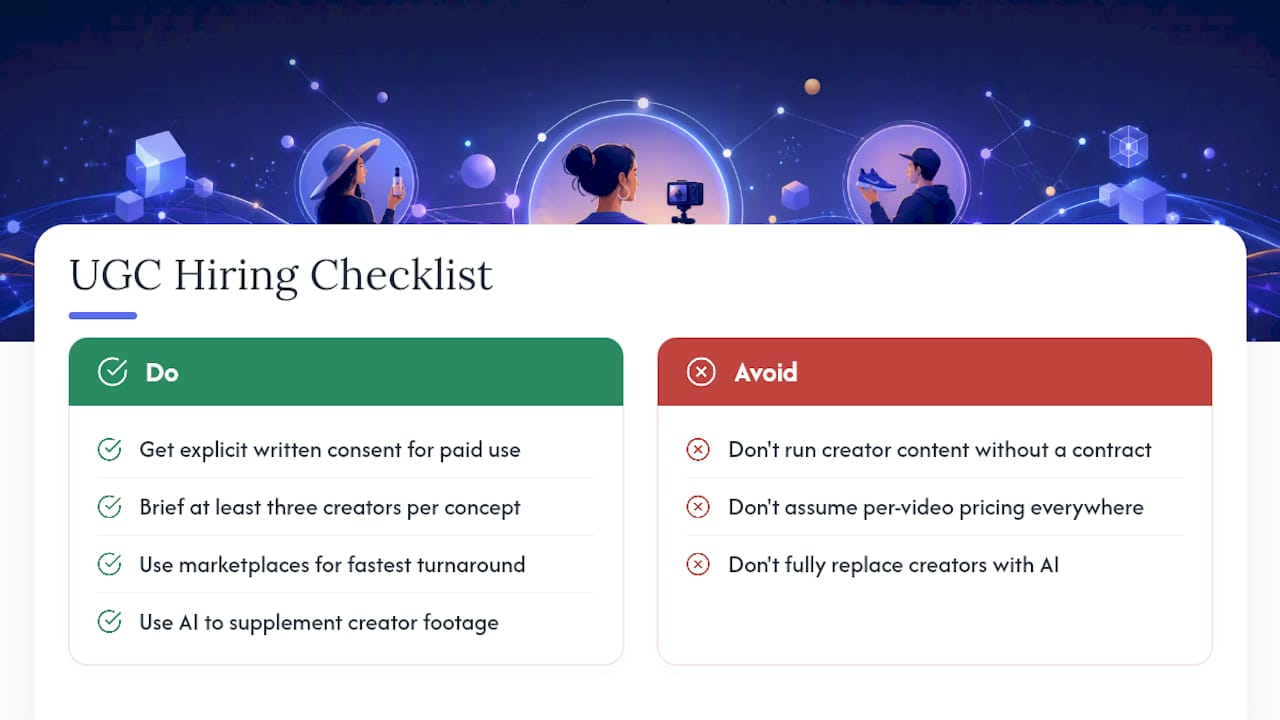
Can AI tools replace UGC creators? Tools like HeyGen, Captions AI, and Arcads can generate talking-head style video content, but they’re typically used to supplement real creator footage, not fully replace it, especially for trust-driven categories where audiences expect a real person.